
T20 cricket is usually about fast runs, big shots, and high strike rates. But there have been moments when Indian batters were forced to slow down, either due to early wickets, tricky chases, or match situations that demanded caution over aggression. These innings may look unusual on paper, but each came with its own context.
Here is a look at the top 5 slowest T20 innings by Indian batters (minimum 20 balls faced).
Top 5 Slowest T20 Innings by Indian
| Rank | Batter | Runs (Balls) | Strike Rate | Opponent | Venue & Year | Match Context |
|---|---|---|---|---|---|---|
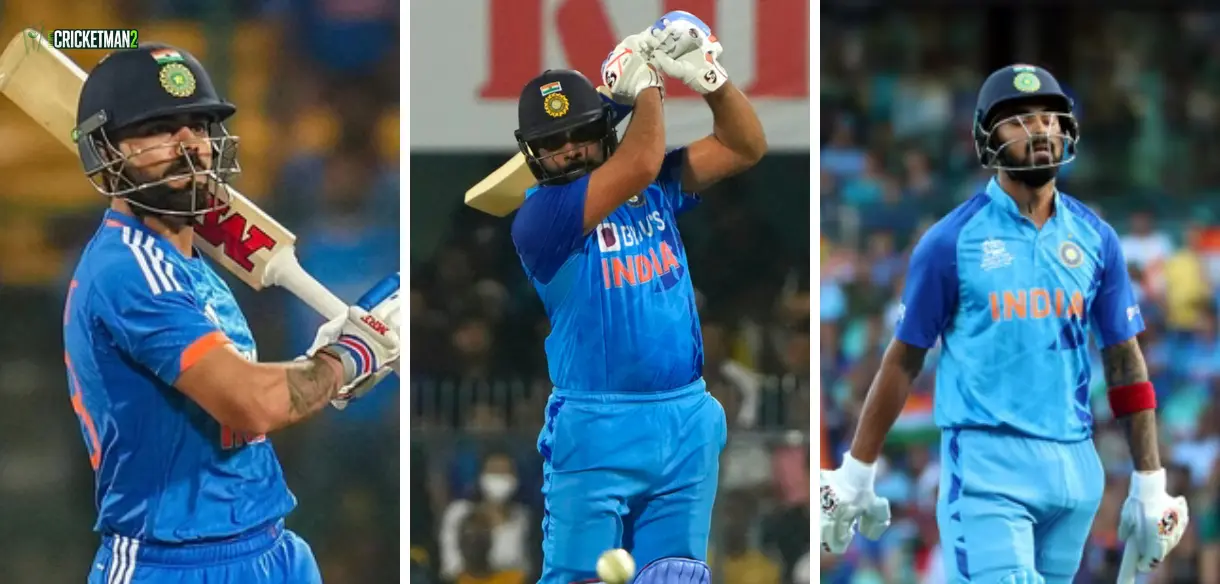
| 1 | Rohit Sharma | 12* (27) | 44.44 | Sri Lanka | Mohali, 2017 | Small chase, early wickets |
| 2 | Virat Kohli | 26* (31) | 83.87 | New Zealand | Lucknow, 2023 | Collapse in powerplay |
| 3 | KL Rahul | 13* (20) | 65.00 | England | Trent Bridge, 2022 | Big chase, pressure situation |
| 4 | Shreyas Iyer | 24 (32) | 75.00 | New Zealand | Ahmedabad, 2023 | Anchor role in chase |
| 5 | Rishabh Pant | 17 (21) | 80.95 | Australia | Mohali, 2019 | Powerplay damage control |
Rohit Sharma – 12 (27 balls) vs Sri Lanka, Mohali 2017*
This remains the slowest T20 innings by an Indian batter. India were chasing just over 100 runs, but lost early wickets. Rohit chose to play risk-free cricket, focusing only on finishing the match. While India won comfortably, his strike rate of 44.44 made this innings stand out as extremely slow for T20 standards.
Virat Kohli – 26 (31 balls) vs New Zealand, Lucknow 2023*
India needed fewer than 80 runs, but a sudden collapse in the powerplay forced Kohli into a cautious approach. Instead of accelerating, he focused on staying till the end. The innings did its job, but a strike rate below 85 is rare for Kohli in T20 cricket.
KL Rahul – 13 (20 balls) vs England, Trent Bridge 2022*
Chasing a big total close to 200, India lost wickets early and fell behind the required rate. Rahul tried to rebuild, but boundaries were hard to find. Even though he stayed unbeaten, his strike rate of 65.00 reflected how difficult the situation was for batting.
Shreyas Iyer – 24 (32 balls) vs New Zealand, Ahmedabad 2023
Iyer played the role of an anchor during a tricky chase. He rotated the strike but avoided big risks, allowing others to attack. While the innings helped stabilize India, the lack of boundaries kept his strike rate well below T20 expectations.
Rishabh Pant – 17 (21 balls) vs Australia, Mohali 2019
Known for aggressive batting, Pant surprised many with this cautious knock. India lost wickets early in the powerplay, and Pant shifted focus to singles and survival. The innings helped India recover, but his strike rate stayed under 81.
These innings prove that T20 cricket is not always about fast scoring. Sometimes, conditions, pressure, and match situations force even aggressive players to slow down. While these knocks may look unusual, they played a role in guiding the team through difficult phases.