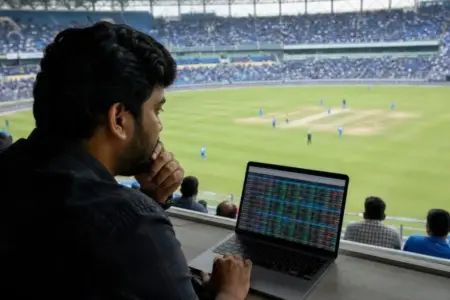


Cricket has always been glorified as a game of instinct, subtlety, and glorious uncertainties. Tradition, gut feeling, and experience influenced the decisions for decades. Nevertheless, in modern times, and particularly in tournaments such as the Indian Premier League (IPL), there is a new question to ask: has cricket experienced its own Moneyball revolution? This increased dependency on statistics and trends is changing the way teams plan and fans speculate on the IPL predictions available, turning the game into a more analytical one.
The ‘Moneyball’ Blueprint: How Data Redefined Baseball
Sabermetrics began to be popularized during the era of Moneyball as a new approach to replace subjective scouting with objective data. In place of conventional statistics such as batting average, teams were putting more emphasis on on-base percentage and slugging efficiency, statistics known to be more directly related to winning.
This change enabled smaller teams to discover underestimated players and play against richer teams. The data became the foundation of decision-making, whether it was hired to in-game tactics. Now baseball is the template of a completely data-driven sport, with analytics ingrained at all levels of competition.
The Data Tsunami: Unpacking Analytics in Modern Cricket
The same has been witnessed in cricket regarding the availability of data. Sensors such as Hawk-Eye can also offer insights on the ball tracking, and systems of tracking players also record the movement, positioning, and responses. Huge ball-by-ball databases have been created, to document every delivery, allowing analysts to discover trends that would never have been visible before.
Specialty companies like CricViz and Opta have significantly contributed to this change. They provide teams and broadcasters with comprehensive analytics in terms of pre-match preparations, strategies on the fly, and post-match analysis. The use of real-time data is becoming more common by captains and coaches to make informed decisions, whether it be bowling adjustments or positioning on the field.
The IPL: Cricket’s Premier Analytics Laboratory
No one could be more noticeable of this data revolution than in the IPL. In mega-auctions, franchises rely on analytics to find undervalued players that fit into particular tactical niches, and not just focus on big names. Scouting based on data has now become a necessity in the creation of balanced squads.
One of them is match-ups. Historical performance is analyzed by teams to ascertain the performance of a certain bowler against a certain batsman, like the success of a leg-spinner against attacking left-handed batsmen. Such understandings affect the choice of teams and tactics in the field.
Visual aids, such as wagon wheels and pitch maps, assist teams to optimize field positions of each player. Meanwhile, the game phases are becoming increasingly the measure of performance: Powerplay, middle overs, and death overs, all with different strategies needed. This analysis in granular form has transformed the playing and understanding of cricket.
Beyond Averages: What are Cricket’s New ‘Smart’ Metrics?
Old statistics such as the average of batting and economy are not complete anymore. Modern player analytics presents new sophisticated measures that can better capture the context and influence.
In the case of bowlers, Expected Wicket is an approximation of the expected number of dismissals a player ought to make according to the quality of the deliveries. With batsmen, such empirical measures as strike rate during particular periods can give more insight into performance under pressure. The Match Impact, a CricViz metric, seeks to measure the overall value of a player to the winning of a match, analogous to baseball WAR (Wins Above Replacement).
The metrics are changing and these are the basis of what may be termed as sabermetrics of cricket. They enable teams to quantify performance according to the nature of the game.
The Verdict: Is Cricket the New ‘Moneyball’ Sport?
Then is cricket a data driven sport as in baseball? The response is both no and yes.
On the one hand, the impact of analytics cannot be ignored. The teams in IPL invest a lot in data analysts, broadcasts are packed with advanced statistics, and strategies are being increasingly influenced by numbers. Information is a key factor in auctions, match-ups, and tactical moves.
Conversely, cricket is still less predictable than baseball. The presence of variables such as pitch conditions, weather variations, and the presence of various formats (Test, ODI, T20) make modelling more difficult. The intuition and adaptability of the captain are also important, as they can often come in handy during a crisis.
Finally, cricket is slowly turning into a hybrid sport, or the one that has been transformed into a perfectly precise and humanly judgmental game.
From Analysis to Action: How Data Powers Today’s IPL Predictions
This has significant consequences to fans and bettors. The past form or the strength of the star does not standalone anymore as the basis of reliable IPL predictions. Rather, they need a more detailed insight into match-ups, location-specific trends, and phase-based performance data.
Through the combination of these insights, analysts are able to come up with patterns which provide competitive advantage. As an illustration, a good record of a team in death-over bowling or a weak batsman in spin can have a huge impact.
This is where professional platforms are involved. They simplify complicated data sets into simple and understandable information to guide the user to make sound decisions. With cricket still welcoming analytics, those who are aware of the details behind the sport are in a better position to predict outcomes and improve their tactics.
Ultimately, the emergence of cricket data analytics does not remove uncertainty but just makes it more informed. And in a game where luck is the order of the day, that could be the greatest benefit of all.