

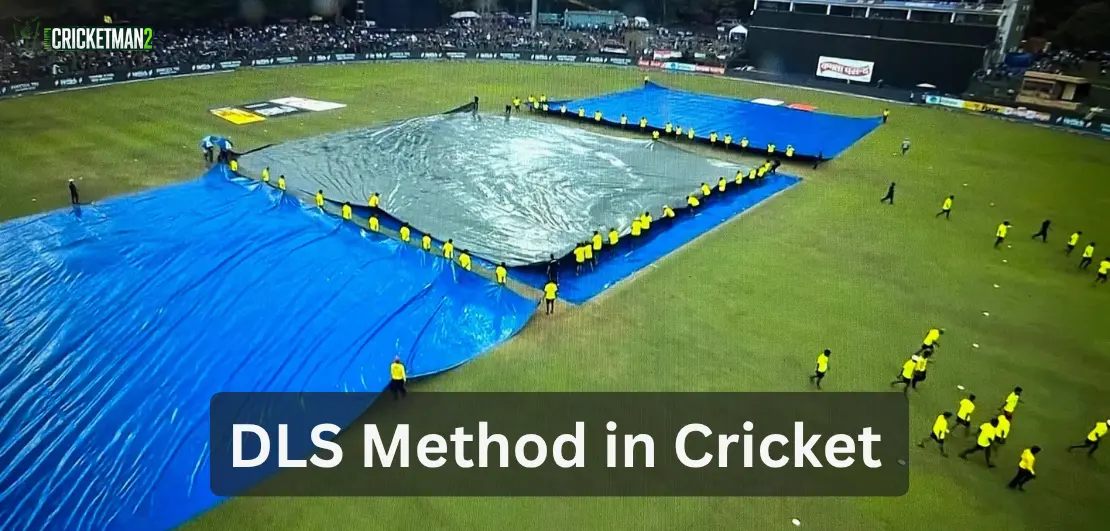
DLS Method is a rule used in cricket to calculate a fair target in rain-affected limited-overs matches such as ODIs and T20s. When bad weather reduces the number of overs, the DLS method adjusts the target for the team batting second based on overs remaining and wickets in hand.
The method is officially approved by the ICC and is considered the most accurate system for deciding results in interrupted matches.
What is DLS Method in Cricket?
The Duckworth–Lewis–Stern (DLS) Method is a mathematical formula used to reset targets in rain-affected matches. Instead of simply reducing overs, it evaluates how many scoring resources a team has left.
In cricket, resources are defined by:
- Overs remaining
- Wickets still in hand
If a team loses overs due to rain, its scoring potential also reduces. The DLS method calculates this reduction and sets a fair target for the chasing team.
DLS Method Overview:
| Category | Details |
|---|---|
| Full Form | Duckworth–Lewis–Stern Method |
| Introduced | 1997 (Updated 2015) |
| Developers | Frank Duckworth, Tony Lewis, Steven Stern |
| Used In | ODIs & T20s (ICC-approved) |
| Main Idea | Balances overs and wickets to calculate fair targets |
| Revised Target Formula | Team 1’s Score × (Team 2 Resources ÷ Team 1 Resources) |
| Tools | ICC DLS Calculator 5.0 |
Full Form of DLS Method
DLS stands for Duckworth–Lewis–Stern Method.
- Frank Duckworth – Statistician
- Tony Lewis – Statistician
- Steven Stern – Updated the model in 2015
The Stern update improved accuracy for modern cricket formats like T20s, where scoring rates are much higher.
Why is DLS Method Used?
Before the DLS method, older systems such as Average Run Rate (ARR) were used. These methods were unfair because they ignored wickets lost.
A famous example occurred in the 1992 World Cup semi-final when South Africa needed 22 runs from 13 balls. After rain interruption, the target changed to 21 runs from 1 ball, making the chase impossible.
The DLS method was introduced to prevent such unfair outcomes by considering both time and wickets.
How Does DLS Method Work?
The DLS method assumes that every team starts with 100% resources. As overs are reduced or wickets fall, the available resources decrease.
If the second team has fewer resources than the first team, their target is reduced proportionally.
Like to know? VJD vs DLS Method in Cricket
DLS Method Formula
Revised Target = (Team 1 Score × Team 2 Resources) ÷ Team 1 Resources
If Team 1 used full overs, their resources are counted as 100%.
DLS Method Example
| Team | Overs | Wickets Lost | Resources | Score |
|---|---|---|---|---|
| Team 1 | 50 | 10 | 100% | 300 |
| Team 2 | 30 | 3 | 70% | ? |
New Target = 300 × (70 ÷ 100) = 210
So, Team 2 must score 211 runs to win
Read Also:- How to Calculate Follow on in Test Cricket
DLS Method Chart (Example for Reference)
| Overs Left | 0 Wickets | 2 Wickets | 5 Wickets | 8 Wickets |
|---|---|---|---|---|
| 50 | 100% | 83.8% | 49.5% | 18.0% |
| 40 | 90.3% | 77.6% | 48.3% | 16.5% |
| 30 | 77.1% | 68.2% | 45.7% | 14.0% |
| 20 | 58.9% | 54.0% | 40.0% | 10.5% |
| 10 | 34.1% | 32.5% | 27.5% | 8.5% |
The table shows how the resources (%) decrease as overs reduce or wickets fall.
DLS Calculator
In professional matches, umpires and officials use a DLS Calculator (Version 5.0), approved by the ICC, to compute revised targets instantly.
You can also use online DLS calculators (like CricHeroes) to simulate rain-affected match scenarios by entering:
- Total overs
- Team 1 score
- Overs lost
- Wickets fallen
- Overs left for Team 2
The calculator then shows the par score and revised target automatically.
Read Also:- Tea Break Time in Test Cricket
How DLS Works in Different Formats
1. In ODI (50 Overs Match)
If a 50-over match is shortened, DLS recalculates the target based on overs and wickets.
- Example: Team 1 scores 280/8 (50 overs)
- Rain reduces Team 2’s innings to 30 overs
- DLS recalculates a new target (around 218–225 runs) depending on wickets and resources.
2. In T20 Matches (20 Overs)
In T20s, where every ball counts, DLS adjustments are even more dynamic.
- Example: Team 1 scores 180/6 (20 overs)
- Rain reduces Team 2’s innings to 12 overs
- The DLS target could be around 130–135 runs, adjusted based on wickets in hand.
How DLS Affects the 2nd Innings
- If rain interrupts before the 2nd innings starts, Team 2’s total overs are reduced, and the DLS target is set before play resumes.
- If it rains during the 2nd innings, the par score (where both teams have equal chances) is recalculated live.
- If play is abandoned mid-innings, the team ahead of the par score at that point is declared the winner.
Key Laws & ICC Usage
- The International Cricket Council (ICC) officially uses the DLS method in all limited-overs formats — ODIs, T20Is, and major tournaments like the Cricket World Cup and T20 World Cup.
- The DLS model is updated every July 1st to adapt to modern scoring patterns (like higher strike rates and Powerplays).
Advantages of the DLS Method
- Considers both overs left and wickets lost
- More accurate and fair than ARR or MPO methods
- Continuously updated for modern scoring
- Handles multiple interruptions smoothly
- Ensures fairness between both teams
Limitations
- Complex for fans to calculate manually
- Sometimes controversial in close matches
- Requires computer software for official results
See Also:- Lunch Break Time in Test Cricket
Summary
The DLS Method is one of cricket’s smartest innovations, ensuring fairness even when rain tries to spoil the game. By balancing overs, wickets, and scoring potential, it preserves the competitive balance in both ODIs and T20s.
While the calculations may seem complex, the principle is simple — every team should get an equal chance to win, no matter how the weather behaves.
Cricket experts and match officials worldwide rely on the DLS method to ensure fair results in rain-affected matches across ICC tournaments.
FAQs
Is DLS method used in Test cricket?
No, the DLS method is only used in limited-overs formats like ODIs and T20 matches.
Who invented the DLS method?
The method was developed by Frank Duckworth and Tony Lewis and later updated by Steven Stern.
What happens if a match is abandoned?
The team ahead of the DLS par score at the time of interruption is declared the winner.
Is DLS method fair?
Yes, it is considered the fairest method as it accounts for both overs remaining and wickets in hand.